
ISCRIVITI ALLA NEWSLETTER
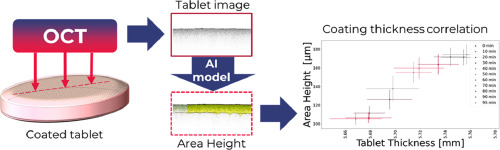
Coating thickness is a critical quality attribute of many coated tablets. Functional coatings ensure correct drug release kinetics or protection from light, while non-functional coatings are generally applied for cosmetic reasons. Traditionally, coating thickness is assessed indirectly via offline methods, such as weight gain or diameter growth. In the past decade, several methods, including optical coherence tomography (OCT) and Raman spectroscopy, have emerged to perform in-line measurements of various subclasses of coating formulations. However, there are some obstacles. For example, when using OCT, a major challenge is scattering pigments, such as titanium dioxide and iron oxide, which make the interface between the coating and the tablet core difficult to detect. This work explores novel OCT image evaluation techniques using unsupervised machine learning to compute image metrics. Certain image metrics of highly scattering coatings are correlated with the tablet thickness, and hence indirectly with the coating thickness. The method was demonstrated using a titanium dioxide rich coating formulation. The results are expected to be applicable to other scattering coatings and will significantly broaden the applicability of OCT to at-line and in-line coating thickness measurements of a much larger class of coating formulations.
https://www.sciencedirect.com/science/article/abs/pii/S0022354924000145